- Item


GENERAL
MMDAs to receive second-quarter DACF transfers this week
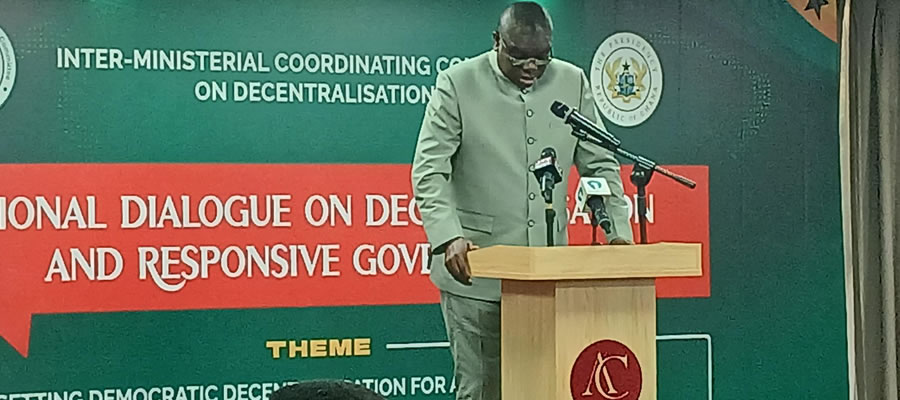
Date Created : 8/12/2026 : Story Author : Benjamin Adamafio Commey/Ghanadistricts.com
Most assemblies have complied with the requirements, while four are yet to meet the conditions for the release of their funds.
The Administrator of the DACF, Mr. Michael Harry Yamson, disclosed this at the National Dialogue on Decentralisation and Responsive Governance in Accra on Tuesday.
He said funds for compliant assemblies were ready for transfer, while those that had not met the requirements would have to wait until they submitted the necessary financial returns.
“Everybody else will get their money between Friday and the following Friday, and those who don't comply, just wait. Your money is at the Central Bank and whenever you comply, you'll get it,” he said.
Mr. Yamson said the DACF had strengthened its compliance mechanisms to ensure that assemblies submitted their financial returns through the Integrated Financial Management Information System (GIFMIS) before transfers were effected.
He explained that the measure was aimed at promoting financial accountability and ensuring that public funds were released only to assemblies that met the required reporting standards.
According to him, the first-quarter transfer process showed that some assemblies delayed submitting their returns while expecting the DACF to release their funds.
He said the DACF had therefore maintained its position that compliance with reporting requirements was mandatory before funds could be released.
Mr. Yamson also urged assemblies to strengthen their internally generated funds (IGF), warning that excessive dependence on DACF transfers could undermine sustainable local development.
He said assemblies could increase their revenue through property rates, market levies and other charges associated with economic activities within their jurisdictions.
“It’s a question of looking at your own economic base rigorously and making some tough choices about making sure that the assembly earns its fair share of these economic flows,” he said.
Mr Yamson said stronger local revenue mobilisation formed part of proposals to transform Ghana’s decentralisation system and reduce assemblies’ dependence on central government transfers.
He disclosed that the DACF was considering mechanisms to incentivise assemblies to increase their internally generated revenue while rewarding those that made stronger efforts to expand their economic base.
The Fund is also pursuing reforms to improve transparency through digital systems, including the Intellects platform, which brings together financial and operational information on assemblies.
Mr Yamson said the system enabled the DACF to monitor financial returns, bank reconciliations and development projects, with project information tracked to electoral areas.
“We’ve built a system that is live, that is transparent and that is accurate. Accurate to electoral area,” he said.
He added that the system would enable the DACF to monitor development spending at the electoral-area level and ensure that assemblies remained up to date with their financial reporting.
He said assemblies that fell into arrears in submitting their returns would have their transfers withheld until they achieved full compliance.
Mr Yamson said the reforms were intended to make accountability an integral part of local governance and ensure that public resources translated into sustainable development.
He also disclosed that the DACF had launched the Community Partners Fund to mobilise additional resources from citizens, the diaspora, corporate bodies and international organisations to support local development.
According to him, the Fund would complement government transfers and strengthen collaboration between assemblies and private-sector financiers to support local development projects.
The ultimate objective, he said, was to move Ghana’s decentralisation system beyond dependence on grants towards greater fiscal, administrative and political autonomy for local governments.
Mr Yamson called for stronger collaboration among Parliament, government institutions, development partners, assemblies and citizens to ensure that decentralisation delivered meaningful development at the local level.
The two-day dialogue was held on the theme: “Resetting Democratic Decentralisation for Accountable Public Service Delivery and Accelerated Local Development.”
It brought together Regional Ministers, Metropolitan, Municipal and District Chief Executives (MMDCEs), traditional leaders, local government experts, development partners, civil society organisations and other stakeholders.
Other Stories



Local Gov Ministry
Int of Local Gov Studies
Ministry of Information
Local Gov Service
Ghana MPs
Ghana Hospitals
NALAG
 facebook
 X
X
 Youtube
 instagram
 whatsapp
 +233 593 831 280
+233 20 230 9497
+233 593 831 280
+233 20 230 9497 0800 430 430
 GPS: GE-231-4383
 info@ghanadistricts.com
 Box GP1044, Accra, Ghana