- Item

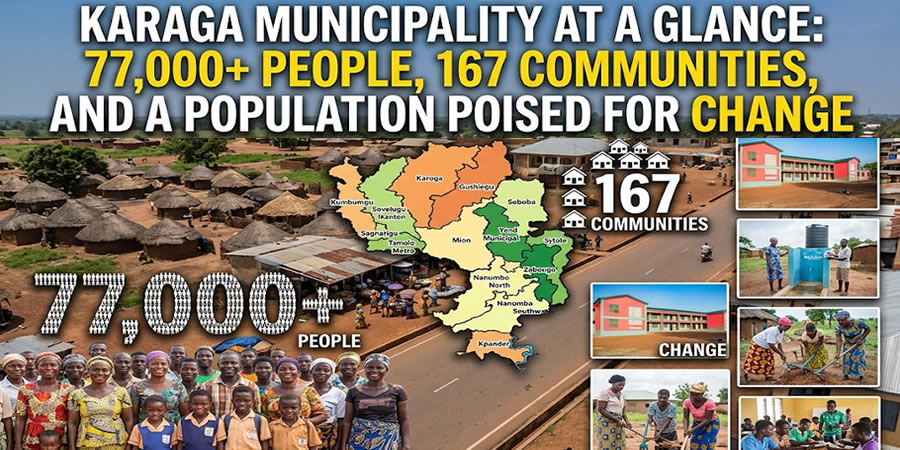
Karaga Municipality at a Glance: 77,000+ People, 167 Communities, and a Population Poised for Change
Date Created : 5/14/2026 7:14:45 AM : Story Author : Ernestina Mensah/Ghanadistricts.com
Counting People, Counting Potential
Numbers tell stories. And in Karaga Municipality, the numbers paint a vivid picture of a growing, predominantly rural population with unique household dynamics, a slight female majority, and a hunger challenge that demands attention.
With 167 communities spread across an undulating savannah landscape, understanding who lives here — and how they live — is essential for planning health, education, water, and economic development.
Let's dive into the data that matters.
Population Growth: Steady Climb
The current population of Karaga Municipality is estimated at 77,706 from the 2010 Population and Housing Census, growing at a steady rate of 2.7%. By 2015, a survey conducted by Monitoring, Evaluation and Technical Support Services (METSS) under the Feed the Future Report recorded a total population of 85,794.
The following year, in April 2016, a survey by the District Health Directorate placed the population at 90,626. Official projections for 2018 estimate the population at 92,719, signaling a young, expanding population that will increasingly need schools, clinics, and job opportunities. At current growth rates, Karaga could cross the 100,000-resident mark by 2026–2027.
Sex Composition: More Women Than Men — A Trend That Holds
Across multiple data sources, one pattern remains remarkably consistent: women outnumber men in Karaga Municipality. According to the 2010 census, females constituted 51.71% of the population while males made up 48.3%. The 2016 Health Directorate survey recorded 46,432 females (51.23%) against 44,194 males (48.76%).
The 2018 projection estimates 47,505 females compared to 45,214 males, while the 2015 METSS survey reported 44,572 females and 41,222 males. This consistent female majority often signals male out-migration for labor opportunities, higher female life expectancy, or both.
The implication is clear: development programs must prioritize women-focused initiatives such as shea processing, microfinance, maternal health services, and land tenure empowerment.
Settlement Pattern: 167 Communities, Mostly Rural
Karaga Municipality is home to 167 communities, predominantly dispersed as rural homesteads with a few larger towns serving as market and administrative hubs. This scattered settlement pattern means that service delivery whether health, education, or water — must reach widely distributed populations.
The implication is clear: CHPS compounds, mobile health clinics, and reliable rural roads are not luxuries they are necessities for connecting every community to opportunity.
Poverty and Hunger: The Hard Numbers behind the Headlines
Not all data is cheerful. Karaga faces real and persistent challenges. The poverty prevalence in the district stands at 18.3%, which translates to approximately 15,700 people living below the poverty line.
The poverty depth measuring how far below the poverty line the average poor person falls is 5.5%, indicating that those in poverty are relatively close to the threshold but still struggle to meet basic needs. Perhaps most concerning is that 9.2% of households experience moderate or severe hunger.
Other stories


Local Gov Ministry
Int of Local Gov Studies
Ministry of Information
Local Gov Service
Ghana MPs
Ghana Hospitals
NALAG
 facebook
 X
X
 Youtube
 instagram
 whatsapp
 +233 593 831 280
+233 20 230 9497
+233 593 831 280
+233 20 230 9497 0800 430 430
 GPS: GE-231-4383
 info@ghanadistricts.com
 Box GP1044, Accra, Ghana