- Item


Sekondi-Takoradi’s Agriculture Sector Powers Local Economy as Thousands Depend on Farming and Fishing
Agriculture remains a lifeline for the people of the Sekondi-Takoradi Metropolis, playing a central role in job creation, food security, and rural livelihoods. Despite being Ghana’s most industrialized twin-city, the metropolis continues to rely heavily on agriculture, with an estimated 85,000 residents engaged in the sector—representing about 20% of the total population.
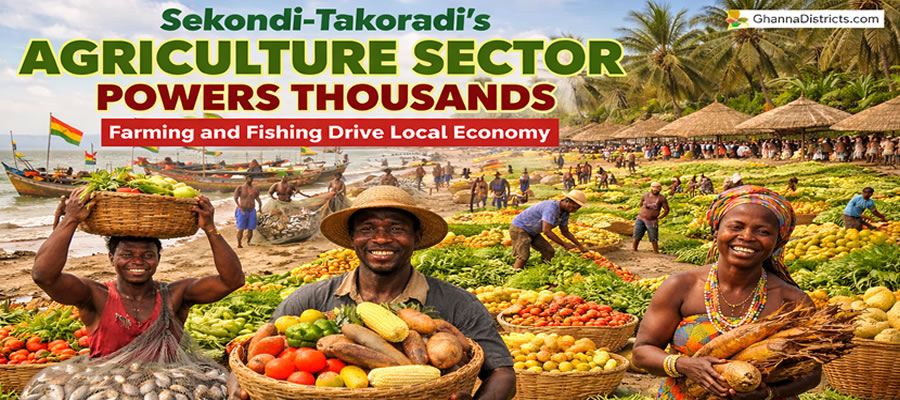
Date Created : 12/22/2025 6:41:49 AM : Story Author : Ghanadistricts.com
Farming Sustains Rural Communities
More than 70% of the rural population depends directly or indirectly on farming and related activities for survival. With 35% of the metropolis’s land area classified as cultivable, agriculture continues to offer opportunities for both subsistence and commercial ventures. The average farm size stands at 2 acres, with most farmers practicing mixed farming, mixed cropping, and mono-cropping for tree crops such as coconut, oil palm, citrus, and cocoa.
Fishing Dominates the Local Economy
Within the agricultural sector, fishing remains the most common occupation, employing fishermen, fish sellers, and fishmongers across the coastal communities. However, many aspiring fishers face a major barrier—the high cost of outboard motors, which limits their ability to enter the trade.
Local stakeholders are calling for increased support to make outboard motors more accessible, enabling more people to participate in the fishing industry and boosting the metropolis’s economic output.
New Opportunities in Non-Domestic Crop Farming
Beyond traditional crops, there is growing interest among residents to venture into non-domestic farm produce, creating new avenues for agribusiness expansion. Stakeholders believe that with the right support, Sekondi-Takoradi could diversify its agricultural base and tap into high-value markets.
Sekondi-Takoradi’s agricultural sector may not always make the headlines, but it remains a powerful engine of growth, sustaining families, creating jobs, and shaping the economic future of the metropolis.
Other stories


GoG Portal
Local Gov Ministry
Int of Local Gov Studies
Ministry of Information
Local Gov Service
Ghana MPs
Ghana Hospitals
NALAG
Local Gov Ministry
Int of Local Gov Studies
Ministry of Information
Local Gov Service
Ghana MPs
Ghana Hospitals
NALAG
 facebook
 X
X
 Youtube
 instagram
 whatsapp
 +233 593 831 280
+233 20 230 9497
+233 593 831 280
+233 20 230 9497 0800 430 430
 GPS: GE-231-4383
 info@ghanadistricts.com
 Box GP1044, Accra, Ghana