- Item


GENERAL
Local Government Service authorises rationalisation, redistribution of staff
Date Created : 10/7/2026 : Story Author : Albert Futukpor/Ghanadistricts.com
The Head of the Local Government Service, Professor Lord Kwaku Mensah, who announced this, said the exercise would involve moving staff from overstaffed MMDAs to areas facing shortages, based on staffing norms, competencies, positions and operational requirements.
He stressed that the exercise was not intended as a form of punishment but rather to ensure that the right number of personnel with the requisite competencies were deployed to the appropriate locations to enhance service delivery.
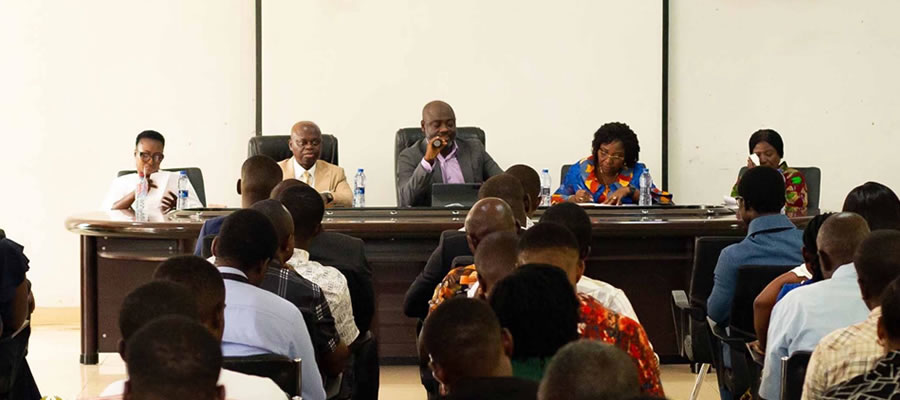
Professor Mensah made this known when he engaged staff of the Northern Regional Coordinating Council (NRCC) in Tamale on Monday as part of his working visit to the region.
He also visited the Savelugu, Sagnarigu and Tamale Assemblies to engage staff and obtain first-hand information on their operations, working conditions, achievements and challenges.
The engagement at the NRCC was attended by staff from various Ministries, Departments and Agencies, who took turns to raise operational challenges and concerns with the Head of the Service.
Professor Mensah said the decision to rationalise staffing followed observations of an uneven distribution of personnel across MMDAs, with some assemblies having more staff than required while others lacked the minimum number of officers needed to operate effectively.
He cited the Tamale Metropolitan Assembly as an example, saying it could have about 17 budget officers under the staffing norms, while some districts might not have the minimum four administrative officers required.
He said Regional Coordinating Directors had consequently been instructed to begin the process of moving officers to areas where their services were needed, in accordance with the rules and conditions of service.
He added that officers who had remained in particular locations beyond the required period could also be posted to other areas, including the Service's headquarters or locations outside their current regions, as part of the workforce planning and rationalisation exercise.
Professor Mensah urged staff to comply with official postings, warning that failure to do so could attract sanctions under the Service's rules and scheme of service.
He said decisions on postings, promotions, deployment and resource allocation would be guided by reliable personnel and operational data to minimise perceptions of bias, favouritism and nepotism.
According to him, the Service was developing web-based Local Government Service Operational Tools to digitise human resource and operational processes and provide real-time data to support management decisions.
He therefore stressed the importance of accurate information from Human Resource units at both the regional and assembly levels to the success of the system.
Professor Mensah said the Service was also focused on professionalising its workforce by promoting discipline, ethical conduct, punctuality and adherence to institutional procedures.
He expressed concern about lateness and absenteeism, saying observations during his recent visits to three MMDAs showed staff attendance levels of about 30, 45 and 50 per cent respectively at the times he visited.
He urged Coordinating Directors and Heads of Department to strengthen supervision and ensure that staff were not only physically present at work but also productive and responsive to their assigned responsibilities.
The Head of the Service cautioned staff against disregarding reporting lines and supervisory authority, noting that weak departmental leadership and poor adherence to institutional hierarchy could undermine coordination and effective service delivery.
He also reminded staff to observe professional dress codes and desist from reporting to work in inappropriate attire.
On personnel records, Professor Mensah expressed concern over alleged attempts by some Human Resource officers to alter dates of birth in official records to extend the working lives of staff.
He said the integrity of personnel records was essential for effective human resource planning and warned that officers found altering official records could face administrative, disciplinary and legal consequences.
Professor Mensah also urged staff to desist from active frontline partisan politics, stressing that public servants were required to maintain political neutrality and ensure continuity in public administration regardless of changes in government.
On staff development, he said the Service was targeting a minimum of 40 hours of training for every staff member annually.
He said management was considering the introduction of a Learning Management System to facilitate online training, self-tutoring and assessments while reducing the cost of continuous professional development.
He added that training opportunities, including short courses, conferences and job-class association programmes, needed to be better structured to improve staff competencies.
Professor Mensah said management would also introduce a more coordinated calendar for job-class association conferences to reduce the pressure such programmes placed on the resources of Regional Coordinating Councils (RCCs) and MMDAs.
The Northern Regional Minister, Mr Ali Adolf John, appealed to the management of the Service to consult the RCCs before transferring officers whose services were considered valuable to the region.
In response, Professor Mensah said he had no difficulty working with officers currently serving in the region and wanted effective public servants to be retained where their experience and understanding of the local government system could contribute to development.
He said officers were public servants and should work with the government of the day irrespective of their political backgrounds, while emphasising the need for discipline, professionalism and effective performance.
Professor Mensah commended the staff for their contributions and expressed his commitment to strengthening the Service through improved workforce planning, professional development and efficient deployment of personnel.
Mr Ali Adolf John also commended Professor Mensah for undertaking the tour of the region, saying it would enable him to familiarise himself with the actual working conditions of officers and the operations of the various MMDAs.
Other Stories









Local Gov Ministry
Int of Local Gov Studies
Ministry of Information
Local Gov Service
Ghana MPs
Ghana Hospitals
NALAG
 facebook
 X
X
 Youtube
 instagram
 whatsapp
 +233 593 831 280
+233 20 230 9497
+233 593 831 280
+233 20 230 9497 0800 430 430
 GPS: GE-231-4383
 info@ghanadistricts.com
 Box GP1044, Accra, Ghana