- Item


SOCIAL
Mamprugu Moagduri District Showcases Strong Traditional Governance Anchored in Cultural Diversity
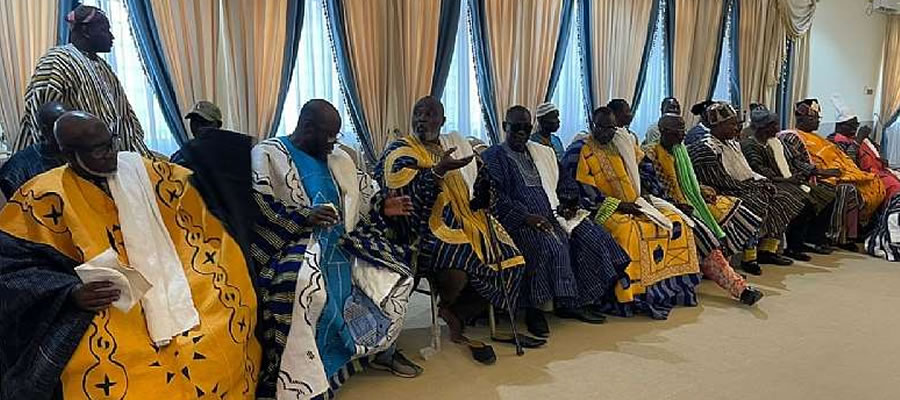
The Mamprugu Moagduri District continues to demonstrate how traditional governance and cultural diversity can coexist to promote unity and local development.
Date Created : 4/21/2026 : Story Author : Mary Ayertey/Ghanadistricts.com
The district is home to several major ethnic groups, including the Mamprusis, Kantonsis, Komma, and Builsas, whose long-standing traditions shape community life. The presence of Fulani settlers, many of whom work as herdsmen for indigenous families, further reflects the district’s multi-ethnic composition and interdependent livelihoods.
Traditional political authority in the district is firmly structured, with the Chief at the helm, supported by a council of elders and functionaries. These include the Wudana (linguist and head of elders), Kpandana (community elders and advisers), Tindana (custodian of the gods), Kanbonnaba (chief warrior), Nachinaa (youth leader), Mangazia (women’s leader), and Fongu Kpamma (sectional heads).
Administratively, the district falls under three main traditional areas—Wungu, Soo, and Wulugu—all of which owe allegiance to the Nayiri, the King of Mamprugu. Some communities in the neighbouring West Mamprusi District also share these paramountcies, reflecting historical governance arrangements.
Islam remains the predominant religion, with the Damba and Fire (Bugum) festivals serving as major cultural events. These festivals have increasingly become platforms for dialogue, conflict resolution, and community engagement, helping to align traditional leadership with modern governance and development efforts.
Other Stories

GoG Portal
Local Gov Ministry
Int of Local Gov Studies
Ministry of Information
Local Gov Service
Ghana MPs
Ghana Hospitals
NALAG
Local Gov Ministry
Int of Local Gov Studies
Ministry of Information
Local Gov Service
Ghana MPs
Ghana Hospitals
NALAG
 facebook
 X
X
 Youtube
 instagram
 whatsapp
 +233 593 831 280
+233 20 230 9497
+233 593 831 280
+233 20 230 9497 0800 430 430
 GPS: GE-231-4383
 info@ghanadistricts.com
 Box GP1044, Accra, Ghana