- Item


AGRICULTURE
Assembly to Boost Cocoa, Coffee and Food Production
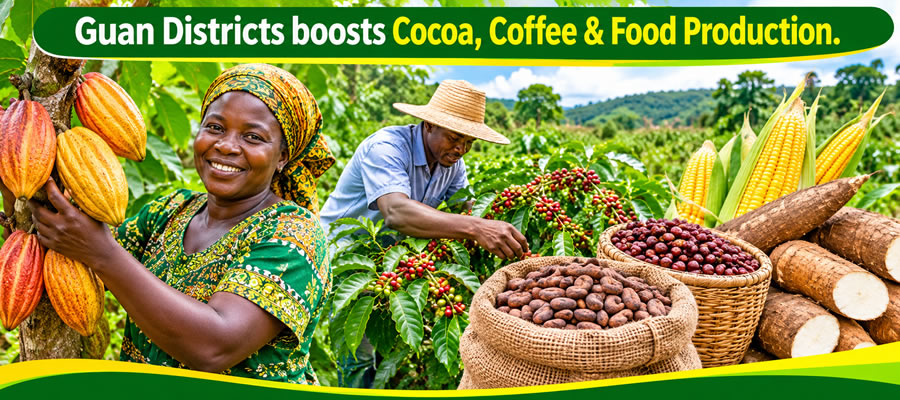
Agriculture remains a major economic activity in the Guan District of the Oti Region, engaging 57.4 per cent of households and providing livelihoods through crop farming, livestock rearing and other agricultural activities.
Date Created : 10/13/2026 : Story Author : Ernestina Mensah/Ghanandistricts.com
The district has about 65,000 hectares of land considered suitable for agriculture, comprising 55,085 hectares for crop production and 9,962 hectares for livestock farming.
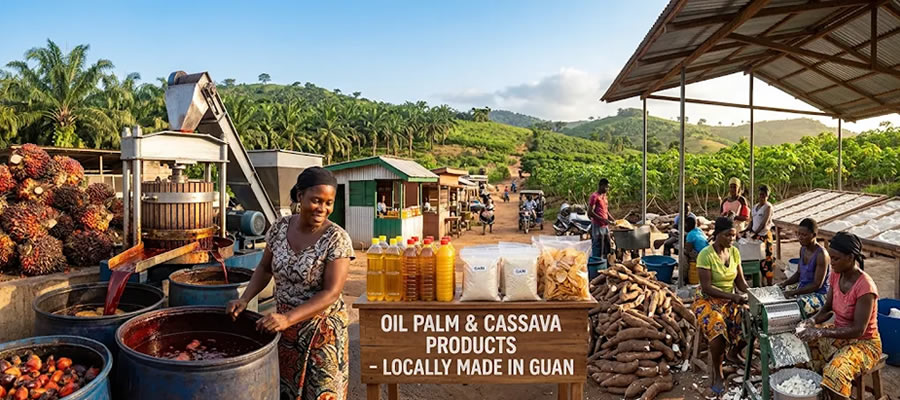
Its favourable climate and soil conditions support the cultivation of food and cash crops, including maize, cassava, rice, plantain, cocoyam, yam, cocoa and coffee. Vegetables such as okro, tomatoes and garden eggs are also cultivated across the district.
Crop farming is the dominant agricultural activity, involving 91.1 per cent of agricultural households, while 47.6 per cent engage in livestock rearing. Tree planting accounts for 3.5 per cent, with fish farming recording the lowest participation at 0.1 per cent.
Most food crop farmers operate on a small scale, using simple hand tools and cultivating an average of 0.5 hectares. Mixed cropping is widely practised, although inorganic fertiliser use has reportedly declined.
Cocoa and coffee are the district's main cash crops, particularly in high-rainfall communities such as Akpafu, Santrokofi, Lolobi and Likpe. However, cocoa production has declined over the years due to ageing trees, inadequate replanting, pests and diseases. Coffee production is also affected by the lack of guaranteed market prices.
Livestock production includes sheep, goats, poultry, pigs and cattle, while fish farming is mainly practised around Guan and Santrokofi.
The district has 24,863 agricultural households, representing 57.4 per cent of all households. Rural households account for 65.3 per cent of those engaged in farming activities, compared with 34.7 per cent in urban communities.
The figures highlight the importance of agriculture to the Guan District's economy and the need for improved farming practices, access to agricultural inputs, stronger market opportunities and investment to increase productivity.
Other Stories






GoG Portal
Local Gov Ministry
Int of Local Gov Studies
Ministry of Information
Local Gov Service
Ghana MPs
Ghana Hospitals
NALAG
Local Gov Ministry
Int of Local Gov Studies
Ministry of Information
Local Gov Service
Ghana MPs
Ghana Hospitals
NALAG
 facebook
 X
 Youtube
 instagram
 whatsapp
 +233 593 831 280
+233 20 230 9497
 0800 430 430
 GPS: GE-231-4383
 info@ghanadistricts.com
 Box GP1044, Accra, Ghana