- Item


ECONOMICS
Minority Caucus demands bipartisan probe into Goldbod’s $214 million loss
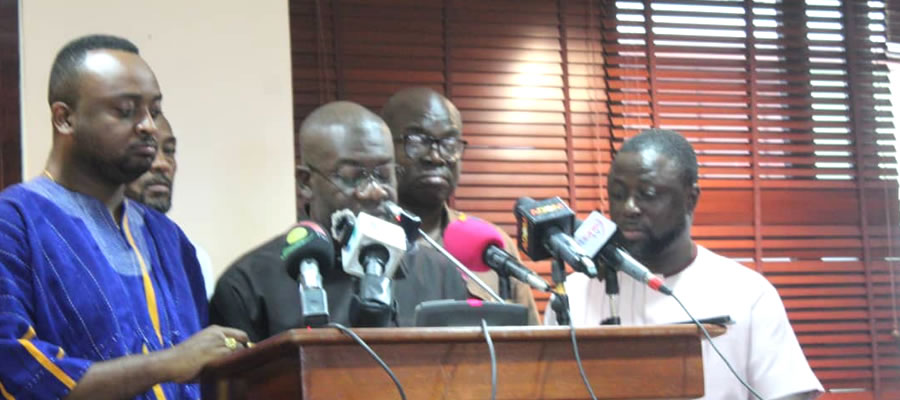
The Minority in Parliament has indicted the government’s management of the national gold procurement programme, now operated by GoldBod.
Date Created : 12/29/2025 : Story Author : Dominic Shirimori / Ghanadistricts.com
Branding the situation a “Golden Betrayal,” the caucus demanded an immediate, bipartisan parliamentary investigation into what it termed “economic sabotage, environmental devastation, and institutional capture,” centering its allegations on massive financial losses and a questionable private monopoly.
The Minority’s call to action is anchored by a startling figure from an IMF report: a projected loss of approximately $300 million in 2025, with $214 million already lost in the first nine months of the year alone.
The caucus argued that these losses, confirmed by government-submitted data to the Fund, are not mere market fluctuations but a direct result of a flawed system design that forces the Bank of Ghana to absorb foreign exchange losses, effectively bleeding state coffers to protect intermediary interests.
At the heart of the allegations is a pointed series of questions about a private entity, Bawa-Rock Limited, and its principal, Alhaji Bawa. The Minority demanded answers on how Bawa-Rock became the sole licensed aggregator for GoldBod, purchasing all artisanal gold nationwide. “Why was a de-facto monopoly created?” the address questioned, insisting that this arrangement stifles competition, enables rent-seeking, and obscures transparency. The caucus declared that public trust is impossible until the selection criteria, beneficial ownership, and necessity of this monopoly are fully disclosed.
The address drew a sharp contrast between the programme’s original implementation and its current form. It praised the previous New Patriotic Party (NPP) administration for growing Ghana’s gold reserves from 8.7 to 31 tonnes without accruing losses, attributing success to the Bank of Ghana buying gold directly for strategic reserves. In contrast, the Minority accused the current National Democratic Congress (NDC) government of transforming the scheme into a speculative trading operation via GoldBod and its private aggregator, resulting in minimal reserve growth—just seven additional tonnes—despite unprecedented trading volumes.
Beyond finance, the Minority linked GoldBod’s operations to the nation’s environmental crisis. It alleged that the state-sanctioned gold-buying scheme has become an unintentional laundering mechanism for illegally mined gold, thereby financing the destruction of forests and the poisoning of rivers with mercury and cyanide. The caucus charged that without rigorous, verifiable traceability, GoldBod cannot prove its gold is not sourced from devastating galamsey operations.
The tone of the address turned to scorn as it described the government’s response as “the arrogance of denial,” referencing a Christmas Day press release from the Bank of Ghana that dismissed the losses as “speculative.” The Minority accused the government of lacking original ideas, merely rebranding existing NPP initiatives like the gold programme without the technical competence to manage them. “The business of gold trading is not for spin doctors,” the statement read, calling the government’s “reset” a cosmetic repackaging rather than a substantive policy vision.
To confront the crisis, the Minority laid out a four-point demand. First, it called for a Parliamentary Ad-hoc Investigative Committee with subpoena powers to examine all contracts, licenses, and the role of Bawa-Rock. Second, it demanded full public disclosure of GoldBod’s fee structures, pricing formulas, and foreign exchange arrangements. Third, it urged immediate environmental emergency measures, including suspend permits in forest reserves and implementing blockchain traceability. Finally, it insisted on accountability, requiring the Governor of the Bank of Ghana and the CEO of GoldBod to appear before the committee, with criminal prosecutions to follow where evidence warrants.
In a direct appeal to the nation, the Minority framed the issue as a transcendent crisis of guardianship over the national patrimony. It called on civil society, faith leaders, traditional authorities, and all citizens to add their voices to demand accountability. “This is not a moment for spectators. It is a moment for citizens,” the address concluded, setting the stage for a high-stakes political confrontation over Ghana’s gold and the integrity of its economic governance. The ball now lies in Parliament’s court to decide whether to convene a probe that could define the early tenure of the current administration.
Other Stories

GoG Portal
Local Gov Ministry
Int of Local Gov Studies
Ministry of Information
Local Gov Service
Ghana MPs
Ghana Hospitals
NALAG
Local Gov Ministry
Int of Local Gov Studies
Ministry of Information
Local Gov Service
Ghana MPs
Ghana Hospitals
NALAG
 facebook
 X
X
 Youtube
 instagram
 +233 593 831 280
+233 20 230 9497
+233 593 831 280
+233 20 230 9497 0800 430 430
 GPS: GE-231-4383
 info@ghanadistricts.com
 Box GP1044, Accra, Ghana