- Item


HEALTH
"Jaman South's Health Care Reality: Few Clinics, Fewer Doctors, and a Long Walk to Help"
Date Created : 2/12/2026 12:00:00 AM : Story Author : Ernestina Mensah/Ghanandistricts.com
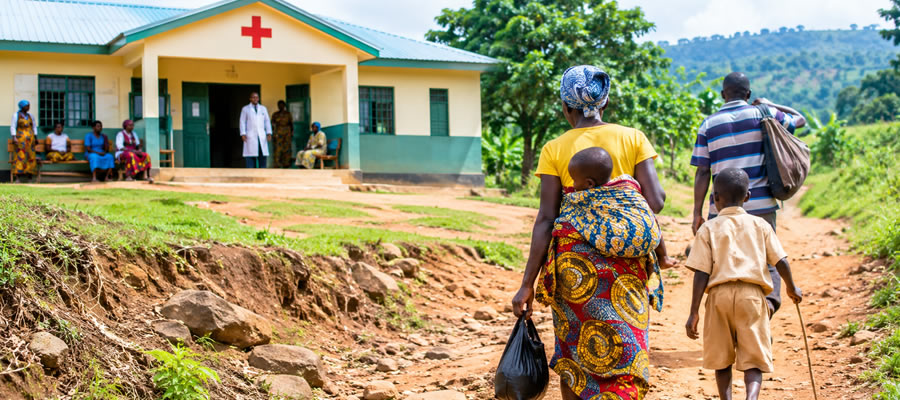
In many parts of Jaman South, the closest point of care is a CHPS compound, a health centre, or in some cases a traditional healer. These facilities are not evenly spread across the district. Instead, they are concentrated, to a very large extent, within the major communities, with most clustered in and around the municipal capital.
The result is a familiar challenge for residents outside the urban centre. For many families, distance is the greatest barrier to health care. Reaching a facility can mean a long journey, lost hours, and real costs, especially for those who live furthest from the capital. When illness strikes, too many people find that help simply too far away.
The pressures on health care in Jaman South do not end with distance. They extend to the people who deliver the care, and here the numbers tell a powerful story.
As of 2025, the Municipality's population-to-doctor ratio stood at 1:12,944. That means a single medical doctor is responsible for the health of 12,944 people. This falls well outside the World Health Organization (WHO) standard of 1:10,000, a clear sign that the Municipality remains under resourced when it comes to its most critical health professionals.
The situation is compounded by a broader shortage of health workers, felt most acutely in the rural areas, where the need is often greatest. Jaman South continues to suffer from inadequate staffing across the health system.
Not every number is a cause for concern. The Municipality's nurses and midwives are comparatively well represented, with a nurse-to-population ratio of 1:987 and a midwife-to-population ratio of 1:844. This is welcome news, and these frontline workers remain the backbone of care in the district.
Yet even this relative strength comes with a caveat. The number of nurses and midwives, while encouraging, is still not enough to cater to every locality in the Municipality. Gaps remain, particularly in the most remote communities.
Meanwhile, other essential health staff, including pharmacists, biomedical scientists and laboratory technicians, are inadequate, limiting the district's ability to offer the full range of diagnostic and pharmaceutical services residents need.
A detailed breakdown of the number and type of health workers in Jaman South is captured in the Municipality's health workforce data, painting a complete picture of both strengths and shortfalls. The message is clear. Jaman South has dedicated people working hard to serve their communities, but the system that supports their needs attention, investment and equitable distribution.
Health care access is not just a local issue. It is a national priority and a measure of how well Ghana delivers on the promise of care for all. Districts like Jaman South remind us that proximity, staffing and equity are the building blocks of a healthier Ghana, and that rural communities must not be left behind.
Related News Headlines


Local Gov Ministry
Int of Local Gov Studies
Ministry of Information
Local Gov Service
Ghana MPs
Ghana Hospitals
NALAG
 facebook
 X
 Youtube
 instagram
 whatsapp
 +233 593 831 280
+233 20 230 9497
 0800 430 430
 GPS: GE-231-4383
 info@ghanadistricts.com
 Box GP1044, Accra, Ghana